What Is MagSafe? Complete Guide to Apple's Magnetic Ecosystem
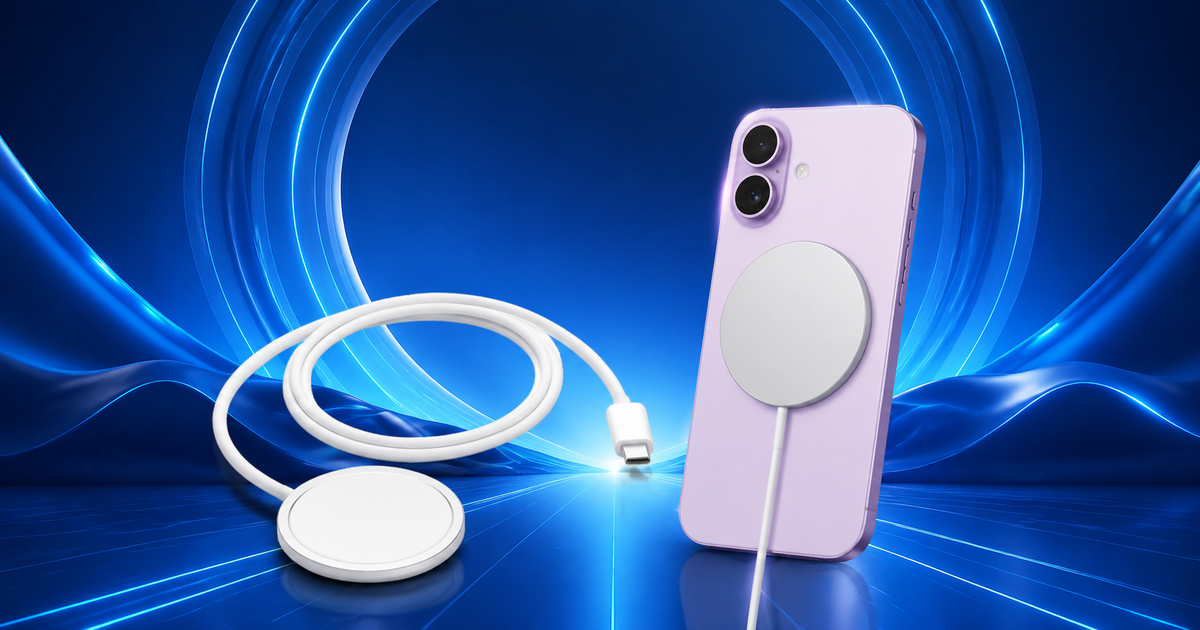
If you've ever seen an iPhone snap onto a charger, wallet, car mount or power bank without a clip or cable, you've probably come across MagSafe.
But MagSafe is more than a ring of magnets on the back of an iPhone. Apple's magnetic system combines magnetic alignment, wireless charging and a growing range of accessories designed to attach securely and work with compatible devices.
At Chips, we see MagSafe-compatible accessories across categories such as power banks, wireless chargers and phone accessories. So, if you're considering an iPhone accessory with MagSafe, understanding what the technology actually does can help you choose the right one.
In this guide, we'll explain what MagSafe is, how it works, which iPhones support it, what you can use it for, how MagSafe differs from Qi2, and what to check before buying a MagSafe accessory.
What Is MagSafe?
MagSafe is Apple's magnetic attachment and charging system.
For iPhone, Apple introduced the modern MagSafe system with the iPhone 12 series in 2020. The system uses an array of magnets around the wireless charging coil to help accessories attach to the correct position on the back of the phone. This precise alignment is particularly useful for wireless charging because it helps keep the charging coils properly positioned.
MagSafe accessories can include:
- Wireless chargers
- Battery packs and power banks
- Phone cases
- Wallets
- Car mounts
- Grips and stands
- Charging stands and multi-device chargers
Apple's current MagSafe accessory catalogue includes cases, wallets, wireless chargers, grips and mounts for compatible iPhone models.
The result is a system that lets you attach, remove and reposition compatible accessories without clips, brackets or adhesive.
MagSafe isn't new to Apple
The name MagSafe actually predates the iPhone.
Apple introduced MagSafe power connectors on MacBooks in 2006. The original idea was simple: the charging cable connected magnetically and could disconnect if someone pulled the cable, helping prevent the notebook from being dragged off a desk.
Today's MagSafe 3 charging connector on compatible MacBooks continues that magnetic charging approach, but it is not the same accessory system as the magnetic ring used by iPhone MagSafe accessories. For example, Apple's current MacBook Air uses a MagSafe 3 charging port and a USB-C to MagSafe 3 cable.
So, when we talk about the MagSafe ecosystem in the context of iPhone accessories, we're primarily referring to Apple's magnetic iPhone accessory system.
How Does MagSafe Work?
The easiest way to understand MagSafe is to think of it as magnetic alignment plus wireless charging and accessory attachment.
A compatible iPhone contains a circular magnet array around its wireless charging system. A compatible MagSafe accessory has corresponding magnets.
When you bring the accessory close to the back of the iPhone, the magnets pull it into the correct position.
That alignment matters because wireless charging works through electromagnetic induction. When the charging coils are positioned correctly, energy can be transferred more efficiently between the charger and the phone. Apple says MagSafe's magnetic alignment provides optimal alignment for faster and more efficient wireless charging.
The magnets aren't what actually transfer electrical power to the phone. The wireless charging coils do that. The magnets help position the charger or accessory correctly.
That's an important distinction.
Apple's technical specifications list a magnet array, alignment magnet, accessory identification NFC and magnetometer under the MagSafe and wireless-charging section.
What Can You Use MagSafe For?
The biggest advantage of MagSafe is that the magnetic connection isn't limited to charging.
It has become a platform for different types of accessories.
1. MagSafe Chargers
A MagSafe charger snaps onto the back of a compatible iPhone and stays aligned while charging.
Apple's current MagSafe Charger can provide up to 25W peak wireless charging on supported iPhone models, when paired with the appropriate power adapter. The actual power delivered depends on the iPhone model, adapter and operating conditions.
This is an important point because not every iPhone receives the same maximum MagSafe charging power.
Apple's current guidance specifies the following maximum MagSafe charging levels with compatible setups:
- Up to 25W: iPhone 17, iPhone 17 Pro, iPhone 17 Pro Max, iPhone 16 Plus and iPhone 16 Pro Max
- Up to 22.5W: iPhone 16 and iPhone 16 Pro
- Up to 20W: iPhone Air
- Up to 15W: iPhone 17e and iPhone 15 and earlier
Actual charging power depends on the iPhone model, MagSafe Charger, power adapter, settings and operating conditions.
So don't assume that buying a higher-wattage charger automatically means your particular iPhone will charge at that speed.
2. MagSafe Power Banks
One of the most practical MagSafe accessories is a magnetic power bank.
Instead of connecting a cable to your phone, you can attach a compatible magnetic power bank to the back of your iPhone and continue using the phone while it charges.
This illustrates an important buying lesson:
Don't assume that every product labelled "MagSafe" has the same charging speed.
Always check the individual product's wireless and wired output specifications.
3. MagSafe Cases
A MagSafe case allows you to use magnetic accessories without removing your phone case.
This is important because a standard phone case can interfere with magnetic attachment if it is too thick or doesn't have the appropriate magnetic system.
A compatible MagSafe case has magnets positioned to work with the iPhone's magnetic system.
Apple offers MagSafe-compatible cases, and third-party manufacturers also make compatible accessories. Apple recommends checking accessory compatibility and certification when buying third-party products.
Do you need a MagSafe case?
If you want to use magnetic accessories regularly, a compatible magnetic case is usually the easiest option.
Without a compatible case, you may need to remove a conventional case before using certain magnetic accessories.
4. MagSafe Wallets
MagSafe also supports magnetic wallets that attach to the back of compatible iPhones or MagSafe cases.
They're useful if you want to carry a small number of cards without using a separate wallet.
However, there is an important practical consideration: a wallet attached to an iPhone can need to be removed when using certain MagSafe charging accessories.
Apple specifically advises removing an iPhone wallet before placing the iPhone on a MagSafe Charger.
So while magnetic wallets are convenient, you shouldn't assume that every MagSafe accessory can be used simultaneously.
5. MagSafe Car Mounts and Stands
Magnetic mounts can make it easier to place an iPhone in a car or on a desk.
A MagSafe-compatible car mount can hold a compatible iPhone in position without requiring a traditional clamp around the phone.
Some stands combine:
- Magnetic phone mounting
- Wireless charging
- Adjustable viewing angles
- Desk or bedside positioning
This can make MagSafe useful beyond charging. The same magnetic attachment system can become part of how you position and use your phone throughout the day.
MagSafe vs Qi2: What's the Difference?
This is one of the most common points of confusion.
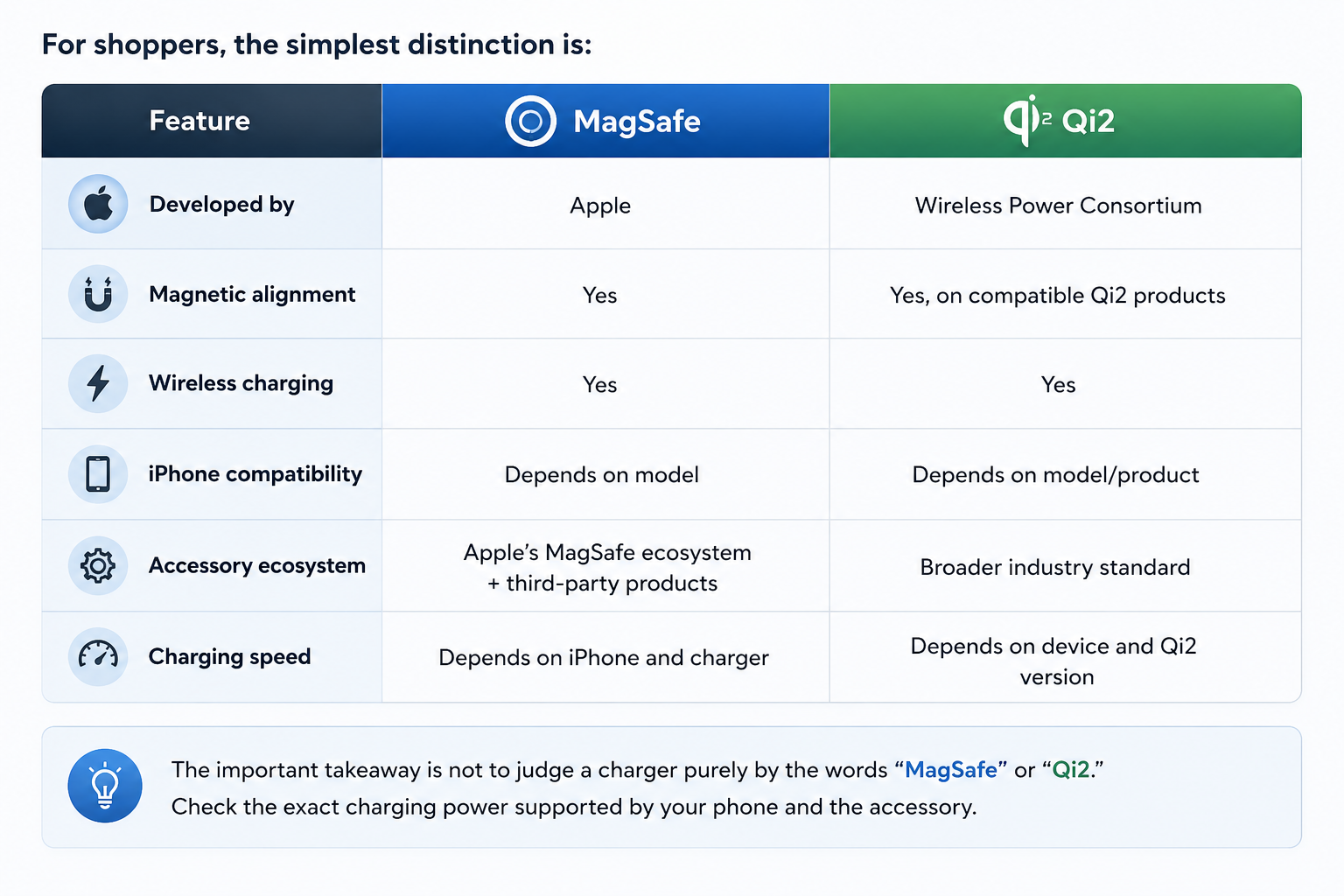
MagSafe and Qi2 are related, but they are not exactly the same thing.
Qi is an open wireless charging standard developed by the Wireless Power Consortium (WPC). Apple iPhones can also charge using Qi-certified wireless chargers.
Qi2 introduced magnetic alignment into the wireless charging standard, making it possible for compatible devices and chargers to achieve more consistent alignment.
Apple's current MagSafe Charger has also received Qi2 25W certification from the Wireless Power Consortium.
Does MagSafe Work with Every iPhone?
No.
This is one of the most important things to check before buying a magnetic accessory.
Apple introduced the current iPhone MagSafe system with the iPhone 12 family. Later compatible iPhone generations continued to support MagSafe. Apple's current support documentation lists MagSafe charging support across multiple generations, including iPhone 12 through newer models.
However, wireless charging and MagSafe magnetic attachment aren't the same thing.
For example, older iPhones can support Qi wireless charging without having the same built-in magnetic attachment system.
Apple says Qi-certified chargers can wirelessly charge iPhone 8 or later, while the magnetic alignment experience is specific to compatible MagSafe models.
So before buying a MagSafe accessory, check your exact iPhone model.
Does MagSafe Work with Android Phones?
This depends on the phone and accessory.
Some Android smartphones support Qi2 magnetic charging, while others may support wireless charging without built-in magnetic alignment.
There are also magnetic cases and accessories designed to add magnetic compatibility to certain phones.
The key is not to assume that a phone supporting wireless charging automatically supports MagSafe.
Always check the manufacturer's compatibility list before buying a magnetic charger, mount or power bank.
Is MagSafe Better Than Wired Charging?
Not necessarily.
MagSafe is primarily about convenience, alignment and accessory flexibility.
Wired charging may be preferable when you want the fastest charging method supported by your particular iPhone, need to transfer data at the same time, or simply prefer a wired connection.
MagSafe is particularly useful when you want to:
- Charge without plugging in a cable
- Keep the phone aligned on a charger
- Use the phone while it is magnetically attached to a battery
- Mount the phone on a compatible stand or car mount
- Switch accessories quickly
So, the better option depends on the situation.
Is MagSafe Safe?
Apple designs MagSafe charging around the iPhone's wireless charging system and magnetic alignment.
However, there are some practical precautions.
Apple advises users not to place credit cards, security badges, passports or key fobs between the iPhone and a MagSafe Charger, because the magnetic and charging fields can damage magnetic strips or RFID chips.
It's also worth remembering that wireless charging can generate heat. Apple notes that an iPhone or MagSafe charging accessory may become slightly warmer during charging, and software can limit charging above 80% when the battery becomes too warm.
For third-party accessories, buy from reputable manufacturers and check compatibility rather than assuming that any magnetic charger will deliver the same performance.
How to Choose a MagSafe Accessory
If you're shopping for MagSafe accessories, don't stop at the word "MagSafe."
Check these specifications first:
1. Your exact iPhone model: Compatibility can vary by generation.
2. Magnetic compatibility: Look for explicit MagSafe or compatible Qi2 support where appropriate.
3. Wireless charging power: A charger rated at 25W doesn't necessarily mean your iPhone will charge at 25W. The phone, charger, adapter and operating conditions all matter.
4. Wired output: For power banks, USB-C output can be significantly faster than wireless output on some models.
5. Accessories included: A power adapter may not be included with a MagSafe Charger, and a keyboard or other accessory may be sold separately depending on the product. Apple's current MagSafe Charger requires a compatible USB-C power adapter, which is sold separately.
Final Verdict: Is MagSafe Worth It?
MagSafe is more than wireless charging.
Its biggest advantage is the combination of magnetic attachment, precise alignment and an expanding accessory ecosystem.
For iPhone users, that can mean snapping a charger into position, attaching a wallet, mounting the phone in a car, adding a stand or carrying a magnetic power bank without dealing with cables every time.
But MagSafe isn't automatically better simply because it is magnetic.
Before buying an accessory, check your iPhone model, charging speed, wireless standard, power requirements and accessory compatibility.
And remember that MagSafe, Qi2 and standard Qi charging are related but different technologies. Understanding the difference can help you avoid buying an accessory that technically attaches to your phone but doesn't provide the charging performance or compatibility you expect.
At Chips, you can explore the current range of MagSafe-compatible power banks, wireless chargers and mobile accessories available in Kuwait and compare the specifications that matter for your setup.
Frequently Asked Questions
What is MagSafe?
MagSafe is Apple's magnetic attachment and charging system. On compatible iPhones, magnets around the wireless charging coil help align chargers and accessories securely with the back of the device. Apple introduced the current iPhone MagSafe system with the iPhone 12 series in 2020.
What is the main benefit of MagSafe?
The main benefit is convenience and alignment. MagSafe accessories can attach magnetically to compatible iPhones, while the magnetic alignment helps position wireless chargers correctly for charging.
Does MagSafe charge faster than regular wireless charging?
It can, depending on the iPhone model, charger, power adapter and conditions. Current MagSafe charging can reach up to 25W peak on certain iPhone models, while other models have lower maximums.
Is MagSafe the same as Qi2?
No. MagSafe is Apple's magnetic charging and accessory system, while Qi2 is an industry wireless-charging standard developed by the Wireless Power Consortium. They share magnetic-alignment technology, and Apple's current MagSafe Charger is Qi2 25W certified.
Does every iPhone support MagSafe?
No. The current iPhone MagSafe system began with the iPhone 12 family. Older iPhones can support Qi wireless charging without having the same built-in magnetic attachment system.
Can I use a MagSafe charger with an Android phone?
It depends on the phone and charger. Some Android phones support Qi2 magnetic charging, while others may require a compatible magnetic case or accessory. Always check the manufacturer's compatibility information.
Do I need a MagSafe case?
Not necessarily. A compatible iPhone can attach directly to MagSafe accessories, but a MagSafe-compatible case allows you to keep your phone protected while using magnetic accessories.
Can MagSafe charge AirPods?
Yes, compatible AirPods charging cases can be charged on a MagSafe Charger. Apple lists several compatible AirPods models and charging cases.
Can MagSafe charge an Apple Watch?
Some MagSafe charging products, such as the MagSafe Duo Charger, combine iPhone/AirPods charging with an Apple Watch charging surface. The exact compatibility depends on the charger and Apple Watch model.